 |B2B交易增长系统

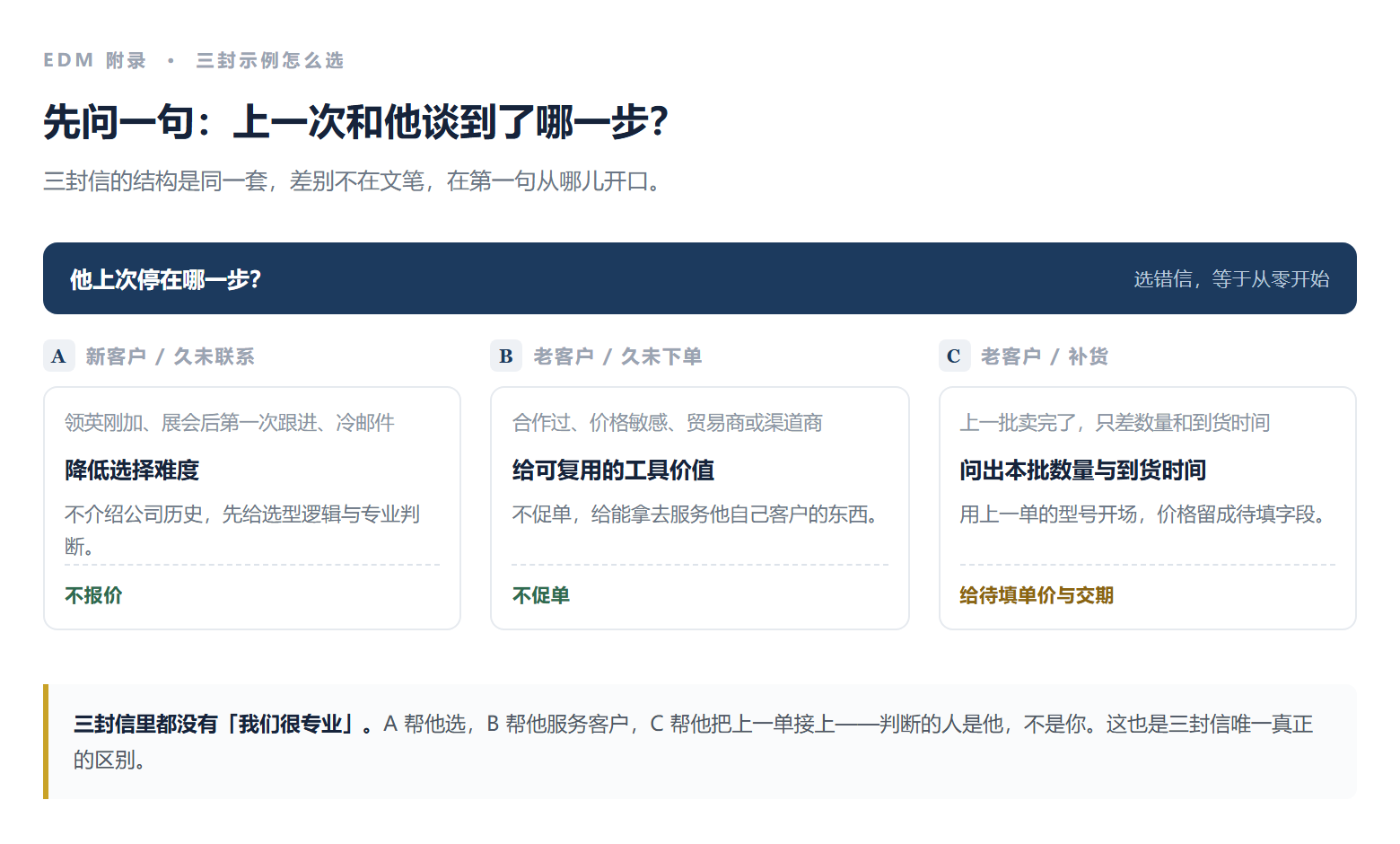
示例 A|新客户 / D2B 客户 #
目标:不是推销,而是帮助对方“快速选对”
适用场景
- LinkedIn 刚加好友
- 展会后第一次跟进
- 冷邮件 / 半冷邮件
- 终端品牌方、非专业采购
核心策略
- 不介绍公司历史
- 不直接报价
- 先输出「选型逻辑 + 专业判断」
电子邮件主题 How brands usually choose the right custom tumbler (quick guide)
Hi {{Name}}, When brands look for custom tumblers, most problems don’t come from pricing — they come from choosing the wrong structure at the beginning.
Based on recent projects, buyers usually focus on three key factors:
- Usage scenario – internal gifts, marketing giveaways, or retail resale
- Material & finish – how it affects durability, branding, and perceived value
- Customization limits – logo position, color constraints, MOQ trade-offs
We recently helped a tech company simplify this decision by visualizing different combinations before production, which reduced back-and-forth and sped up internal approval.
If helpful, I can share a simple interactive example showing:
- how different choices change the final result
- what usually causes delays or hidden costs
No sales pitch — just a clearer way to evaluate options.
Best regards,{{Your Name}}
为什么这封信有效? #
- 新客户不怕信息少,怕选错
- 你在做的是:
👉 “帮我把复杂决策变简单” - 不直接提 XR,但把入口埋好
示例 B|老客户 / 专业买家 #
目标:不是再卖产品,而是“赋能他的业务”
适用场景
- 合作过但久未下单
- 老客户价格敏感
- 贸易商 / 渠道商 / 专业采购
- “最近没需求”的客户
核心策略
- 不促单
- 不强调产品优势
- 提供「可反复使用的工具价值」
电子邮件主题 We built a tool that helps your customers decide faster.
Hi {{Name}}, We’ve been working on something recently that might be useful for your customers.
Instead of sending images, PDFs, or long explanations, we created a way for buyers to:
- view different tumbler options clearly
- understand logo placement & finish impact
- make decisions without long back-and-forth
Some of our partners are using this as a free service tool when talking to their downstream clients — not to sell harder, but to make discussions easier.
If you’d like, I can show you how it works and see whether it fits your current workflow.
No obligation — just sharing something that’s been working well.
Best regards,{{Your Name}}
为什么这封信能激活沉睡客户? #
- 老客户的第一反应不是“要不要买”
- 而是:
👉 “这个能不能帮我更好服务客户?” - 你从供应商 → 能力支持者
示例 C|老客户补货 #
目标:把「这一批要多少」问出来,而不是重新介绍一遍
适用场景
- 上一批已经卖完或快到补货点
- 型号、包装、价格都谈过,只差数量和到货时间
- 客户习惯「要的时候再联系」,需要你先开口
核心策略
- 用他上次买的型号开场,不用公司介绍开场
- 只问三件事:型号、数量、期望到货时间
- 价格与交期留成待填字段,先确认信息再给准数
电子邮件主题 Reorder for {{last order model}} — {{quantity}} pcs
Hi {{Name}},
Your last order was {{last order model}} ({{spec}}), shipped in {{last order month}}.
If you are planning the next batch, here are the conditions we can hold for you:
· Model: {{model}}
· Quantity: {{quantity}} pcs
· Unit price: {{unit price}} {{currency}} / pc ({{incoterm}})
· Lead time: {{lead time}} days after deposit
· Estimated delivery: {{requested delivery date}}
If the model and quantity are still right, reply “confirm” and I will book production for {{requested delivery date}}.
If anything changed — colour, lid, packaging or artwork — tell me which part, and I will update the quotation before we start.
Best regards,
{{Your Name}}
为什么这封信能推进补货?
- 客户不需要重新回忆上次买的是什么——型号和月份已经在第一行
- 回复门槛降到一句话:「confirm」,或者「数量改成 {{quantity}}」
- 价格和交期是待填字段,先谈信息,再谈条件,不会因为报错一次价格把节奏拖死
- 最后一句把「改了颜色或包装」也接住了,客户改需求时不用另开一封邮件
{{model}}、{{quantity}}、{{unit price}}、{{lead time}}、{{requested delivery date}} 都是待填字段。发出前确认上一单的型号与包装没有变动;如果工艺或配件改过,先在记录里更新,再发这封信。
对照总结,策略差异 #
| 项目 | 新客户 / D2B | 老客户 / 专业买家 | 示例 C / 老客户补货 |
|---|---|---|---|
| 邮件目标 | 降低选择难度 | 提供工具价值 | 问出本批数量与到货时间 |
| 核心内容 | 选型逻辑、决策结构 | 可复用能力 | 上次型号、本次数量、期望到货 |
| 是否报价 | ❌ 不报价 | ❌ 不报价 | ✅ 给待填单价与交期 |
| 是否介绍公司 | ❌ 极少 | ❌ 不需要 | ❌ 从上一单开场 |
| Xorder / XR 角色 | 理解工具(隐形) | 赋能工具(后台) | 调出上次型号;定制件可复用配置 |
总结 #
前述的 3 封示例是给启发和参考,可以根据实际情况进行调整优化。利用好新的能力,给客户带去新的价值,也给自己创造更多的新机会。
EDM 不是用来“推产品”的,而是用来“让对方更容易做决定”的。
< 返回专题页封面